

What to Remember
The 18-month rule: Using a bottle beyond this age dramatically increases the risk of tooth decay.
Pacifier vs. thumb: The pacifier is the better choice because you can make it “disappear.” The thumb is always there.
Open bite: The most common orthodontic problem caused by prolonged sucking habits.
Breastfeeding: It does not cause tooth decay on its own, but it does call for cleaning the teeth once solid foods have been introduced.
Caring for children’s teeth often feels like a race. On the one hand, you want to soothe your child with a pacifier or a bottle, and on the other, you worry about their smile in the future.
Based on our experience and the latest data in pediatric dentistry, we know that what is needed is not panic, but a strategy. Let’s look at which habits are truly harmful and how to handle them wisely.
Many parents think: “They’re going to fall out anyway, so why worry?” This is a dangerous misconception.
Baby teeth act as natural “space maintainers” for the permanent teeth. If they are lost early because of tooth decay or bad habits, the neighboring teeth drift and close the gap, trapping the permanent tooth that is waiting to come in. In addition, they are essential for proper speech articulation and chewing, directly affecting the child’s nutrition.
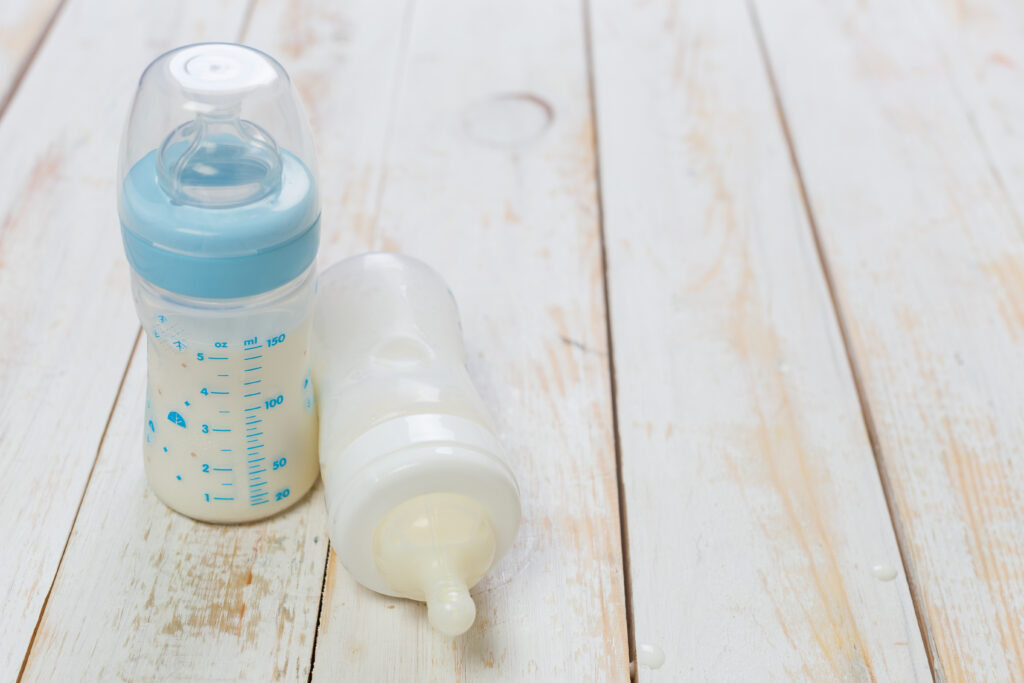
The bottle, especially during sleep, is the number one enemy of tooth enamel in infants.
When a child sleeps with a bottle in their mouth, liquids containing sugars (milk, juice) pool around the teeth, creating the perfect environment for acid-tolerant bacteria. This leads to what is known as “Baby Bottle Tooth Decay.” Unlike ordinary tooth decay, it progresses rapidly and can destroy the front teeth within a few months, leaving black spots or broken teeth.
There is a fine line here that is often misunderstood.
Breastfeeding on its own rarely causes tooth decay, since breast milk contains lactoferrin, which inhibits the growth of bacteria. However, the risk changes dramatically once the child starts solid foods.
We often see that the combination of food residue and night breastfeeding (without cleaning the teeth) creates a problem. Saliva flow decreases at night, reducing the mouth’s natural protection. The solution is not necessarily to stop breastfeeding, but to clean the teeth thoroughly before bed and, if possible, to offer a little water after the milk.
If we had to choose the “lesser evil,” the scales tip in favor of the pacifier. Why? Because you can throw a pacifier away. The thumb is built into the child’s body.
Both habits, if prolonged, put pressure on the palate and the front teeth. The result is often an Open Bite, where the upper and lower teeth do not touch each other when the mouth closes, leaving a gap. This can lead to a lisp and the need for long-term orthodontic treatment. Stopping thumb sucking is clearly harder for the child psychologically.
There is no magic switch, but there are age “red lines” to keep in mind so you can prevent permanent damage:
Bottle: Start cutting back at 12 months. The goal is to stop completely by 15-18 months.
Pacifier: Ideally, use should be limited after age 1 and stop completely by age 2-3. After age 3, the risk of orthodontic deformity increases sharply.
Thumb sucking: Most orthodontic changes are reversible if the habit stops before the permanent teeth come in (around age 5-6), but it is best to address it earlier, around age 3-4.
Forget the yelling and the punishments. Breaking the habit takes finesse.
Positive Reinforcement: Use a reward chart. Every day without thumb sucking or a pacifier earns a sticker.
Replacement: When the child asks for a pacifier or puts a thumb in their mouth, give their hands something else to do (e.g., a stress ball) or offer water. Often the habit is the result of boredom or anxiety, not a real need.
Do the teeth go back into place if the child stops using the pacifier?
Yes, in most cases. If the habit stops early (before age 3-4), the so-called “self-correcting ability” of the jaw and tongue can bring the teeth back to the right position within a few months, without “braces.”
What should I do if my child can only sleep with a bottle?
Try the “dilution” method. Every night, dilute the milk with more and more water. Within 2 weeks, the bottle will contain only water. This way, you temporarily keep the habit but eliminate the risk of tooth decay.
What is the difference between an orthodontic pacifier and a regular one?
An orthodontic pacifier is designed with a flatter shape on the underside to mimic the nipple during breastfeeding and to put less pressure on the jaw. However, even an orthodontic pacifier can cause problems if it is overused.
The information in this article is purely informational in nature and cannot replace an individualized clinical diagnosis and treatment. For any concern about your child’s oral health, always consult your pediatric dentist.