

Children’s dental sealants, also known as pit-and-fissure sealants, are thin protective coatings applied to the chewing surfaces of the back teeth, mainly the permanent molars. Their purpose is to cover the deep grooves where bacteria and food debris are trapped, so that the risk of cavities is reduced through a simple and usually painless preventive procedure.
At Happy Tooth Clinic in Voula, the decision about sealants is made after a pediatric dental evaluation. They are not applied to every child and every tooth in the same way. We examine which teeth are at greater risk, which children have more difficulty with cleaning, and when the right time is for a preventive intervention.
Sealants are thin protective coatings placed in the grooves of the back teeth, where the toothbrush does not always clean effectively. They work like a barrier on the chewing surface and help keep food and bacteria from getting trapped in the areas with the highest risk of cavities.
The first permanent molars are often the teeth that benefit the most. They come in early and are used heavily from a young age. When they have deep grooves, prevention is even more valuable.
Important: sealants are a preventive measure. They do not replace proper oral hygiene or other pediatric dental procedures when these are needed.
For most children, sealants are considered once the first permanent molars have fully erupted, usually around the age of 6–7, and again when the second permanent molars erupt, usually around the age of 11–13. However, the right timing always depends on the child’s clinical picture and cavity risk.
We do not need to wait for a problem to appear. For children with a history of cavities, deep grooves, or difficulty brushing thoroughly, preventive coverage can offer a real benefit.
A practical example is a child aged 6–7 who has just gotten their first permanent molars. If the grooves are deep and brushing is not enough, sealants can be included early in the prevention plan.
Sealants are applied mainly to the chewing surfaces of the back teeth, that is, the molars and, in some cases, the premolars, when the grooves are deep and easily trap food and bacteria.
Children who often benefit the most are those with:
Not all teeth need a sealant. The choice is made tooth by tooth and not only child by child.

Applying sealants is usually painless, quick, and non-invasive. In most cases anesthesia is not required, because this is not a filling with drilling but a preventive coating of the chewing surface.
The procedure usually includes:
For many children this is a much easier experience than a treatment procedure. This matters when we want the child’s contact with the pediatric dentist to stay positive.
Sealants can last for several years, but they need to be checked at regular follow-up visits. Over time they may wear down in some spot or need reinforcement, which is why monitoring is an important part of prevention.
Helpful answer: Sealants are not considered “placed and done.” They need to be rechecked by a pediatric dentist so that they remain effective.
Sealants, fluoride, and fillings are not the same thing.
The most common mistake is for a parent to think that sealants replace everything. They do not replace brushing, home care, diet, or regular check-ups.
Sealants are not a solution for every case. If the tooth already has damage that is not suitable for preventive coverage, if there is pain, or if the clinical picture shows that another restoration is needed, then the pediatric dentist will recommend a different approach.
This is one of the most important points for parents. The right question is not only “should we put sealants on?” but “is this the right step for this specific tooth at this moment?”
There is no point in considering the cost of sealants in isolation from the clinical picture. The right question is whether the child and the specific teeth will truly benefit from the application.
The final estimate usually depends on the number of teeth to be covered and on the child’s overall picture. For this reason, the right approach is evaluation first, and then clear information about what is needed.
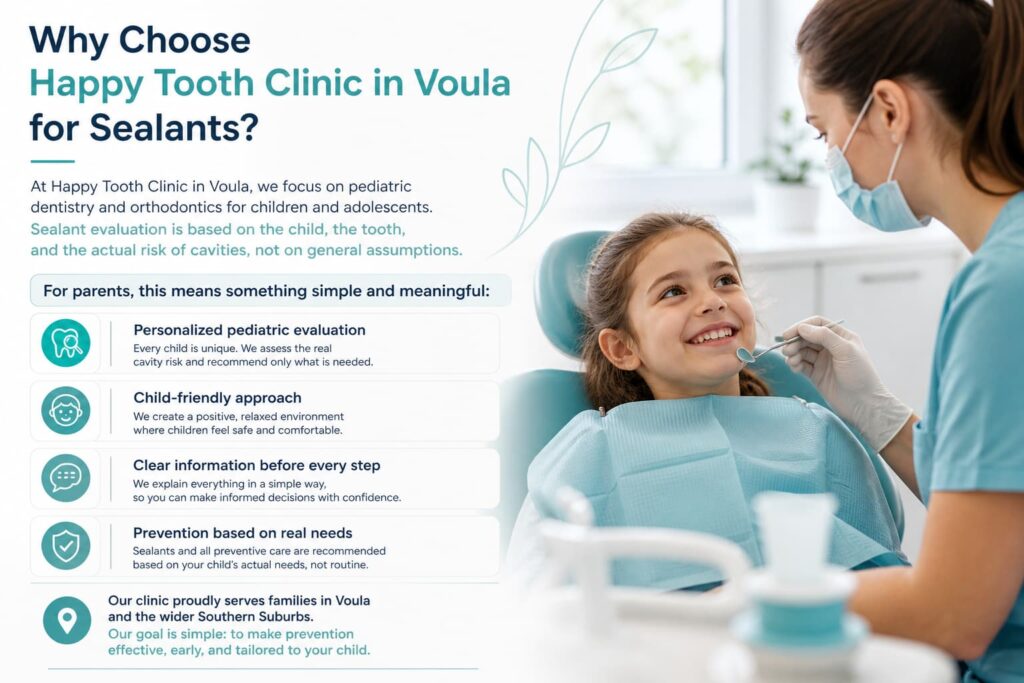 Why Choose Happy Tooth Clinic in Voula for Sealants?
Happy Tooth Clinic in Voula focuses on pediatric dentistry and on orthodontics for children and teens. The evaluation for sealants is based on the child, the tooth, and the actual risk of cavities, not on general assumptions.
For the parent, this translates into something simple and meaningful:
The clinic serves families from Voula and the wider Southern Suburbs of Athens, with the goal of making prevention happen correctly and early.
No. Sealants are an additional preventive measure. Proper brushing, a balanced diet, and regular check-ups remain essential.
In practice, they are applied most often to the permanent molars of children and teens, because that is where the greatest risk of cavities in the chewing grooves is often found.
It needs to be rechecked by a pediatric dentist and, if necessary, repaired or reapplied at the specific spot.
Yes. When applied correctly and in the appropriate clinical setting, sealants are considered a safe and effective preventive measure.
If your child has just gotten their first permanent molars, if you see deep grooves, or if there is a history of cavities, a preventive pediatric dental check-up can show whether sealants are the right choice now.
At Happy Tooth Clinic in Voula, the evaluation is based on the child’s real needs and not on general rules.
This content is informational and does not replace a clinical examination by a pediatric dentist. The choice of sealants is made after a dental evaluation of the child.