

Many parents mistakenly believe that orthodontics is only about aesthetics and that they must wait until adolescence to “straighten” their child’s teeth.
The truth is different. Preventive orthodontics is not simply about a beautiful smile. It is a matter of health, proper breathing and healthy skeletal development. Think of it as the preparation of the ground before you build a house: if the foundations (jaws) are not right, the house (teeth) will never stand properly.
Key Takeaways:
The “Magic” Number 7: The first visit should take place at the age of 7, no later.
It’s Not Just for “Crooked Teeth”: It concerns the expansion of the jaws and the improvement of breathing.
Prevention vs. Treatment: Early intervention can prevent the need for permanent tooth extractions in the future.
Preventive orthodontics (Phase 1 orthodontics) is early intervention during childhood, aimed at guiding the growth of the jaws and creating the necessary space for the permanent teeth to erupt.
Unlike classic orthodontics, which moves teeth, preventive treatment focuses mainly on facial orthopedics. It corrects skeletal imbalances (e.g. a narrow upper jaw) while the child’s bones are still malleable and developing.
According to the American Association of Orthodontists, the first evaluation should take place no later than the age of 7.
Why then? At this age the first permanent molars have come in, which determine the occlusion (bite). An experienced orthodontist can “read” the growth and spot problems that are not visible to the parent’s naked eye, such as hidden skeletal asymmetries.
Based on our clinical experience, many children who come for the first time at 11 or 12 years old have lost the “window of opportunity” for easy skeletal correction, leading to more complex and time-consuming treatments.
You don’t have to be a doctor to spot the first warning signs. Observe your child in daily life:
Early or delayed loss of baby teeth: If baby teeth fall out very early (e.g. from decay) or are excessively late.
Mouth Breathing: The child constantly breathes through the mouth, snores or sleeps with the mouth open (often associated with a narrow upper jaw).
Difficulty chewing: If the child has difficulty biting or chewing food.
Thumb Sucking: If the habit continues after the age of 4-5.
Crowding: Teeth that come in overlapping one another.
Protruding teeth: Teeth that “stick out” toward the front, increasing the risk of injury.
Crossbite: When the lower jaw closes outside the upper jaw at some points.
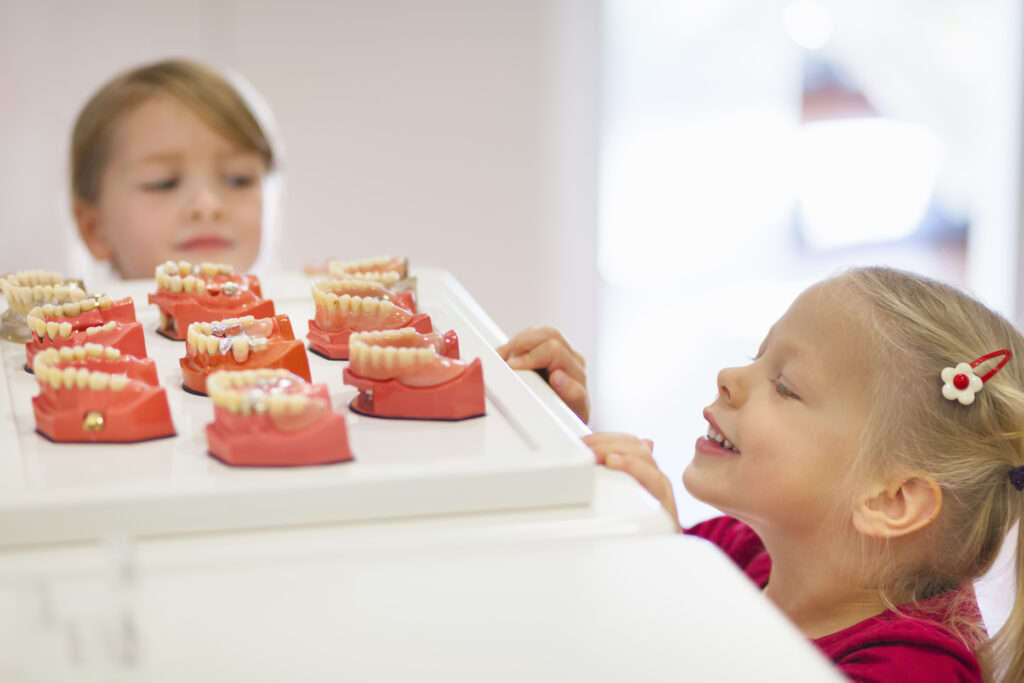
Modern pediatric dentistry and orthodontics have tools that are far more advanced than the old, bulky appliances.
When a baby tooth is lost early, the neighboring teeth tend to move and close the gap. This appliance “holds the position” open so that the permanent tooth can come in properly.
They are used when the upper jaw is narrow. With gentle pressure, they gradually widen the jaw, creating room for the teeth and at the same time improving nasal breathing.
Yes, there is now a braces-free option for children aged 7-10 as well. The clear aligners are designed specifically for small dental arches, are removed for eating, and allow excellent oral hygiene.
This is the most frequent question we receive. Let’s be honest:
Preventive orthodontics does not guarantee 100% that the child will not need braces later (Phase 2).
However, Phase 1 ensures that:
Future treatment will be significantly shorter.
Permanent tooth extractions will be avoided.
Jaw surgery will not be needed.
The child will be in a better emotional state during the sensitive years of early adolescence.
The visit to the orthodontist is no longer scary. Forget the “putty” that used to trigger a gag reflex.
Digital Era: We use intraoral scanners to take three-dimensional (3D) measurements of the teeth in a few minutes, painlessly and in a fun way for the child.
Treatment Duration: The preventive phase usually lasts from 9 to 15 months, depending on the severity of the problem.
Appointment Frequency: Visits usually take place every 4-8 weeks.
Modern appliances are designed for minimal discomfort. There may be a feeling of pressure for 2-3 days after placement or activation, which is easily managed with simple pain relievers, but there is no sharp pain.
EOPYY (the National Organization for the Provision of Health Services) provides some coverage for orthodontic treatments in children, under certain conditions (age limits and severity of the problem – e.g., lip, age 13). We recommend that you ask your orthodontist about the current legislation and the reimbursement process.
Of course. For contact sports (basketball, soccer, martial arts), we recommend the use of a special protective mouthguard over the braces or the appliances to avoid injuries.
Cooperation is key. That is why we often choose fixed appliances (which cannot be removed) or methods such as Invisalign First that have compliance indicators, so that we can check whether the child wears them as much as they should.
Your child’s health is the best investment. If your child is approaching the age of 7 or you notice any of the above signs, don’t wait.
Note: The information in this article is for informational purposes and does not replace professional medical advice.